5-Minute Opening Talk for Artist Kim Young-hwa’s Exhibition
— From the Perspective of the New Art Theory, Qiosmosis
By Professor Hong Ki-ro
Author of "Qiosmosis: A New Ontology of Art, Reality, and Civilization"
I am Hong Ki-ro, the author of Qiosmosis: A New Ontology of Art, Reality, and Civilization. It is my great pleasure and honor to share a few words about the artistry of Kim Young-hwa on this auspicious occasion.

Artist Kim Young-hwa’s current exhibition is not merely a solo showcase. Unfolding
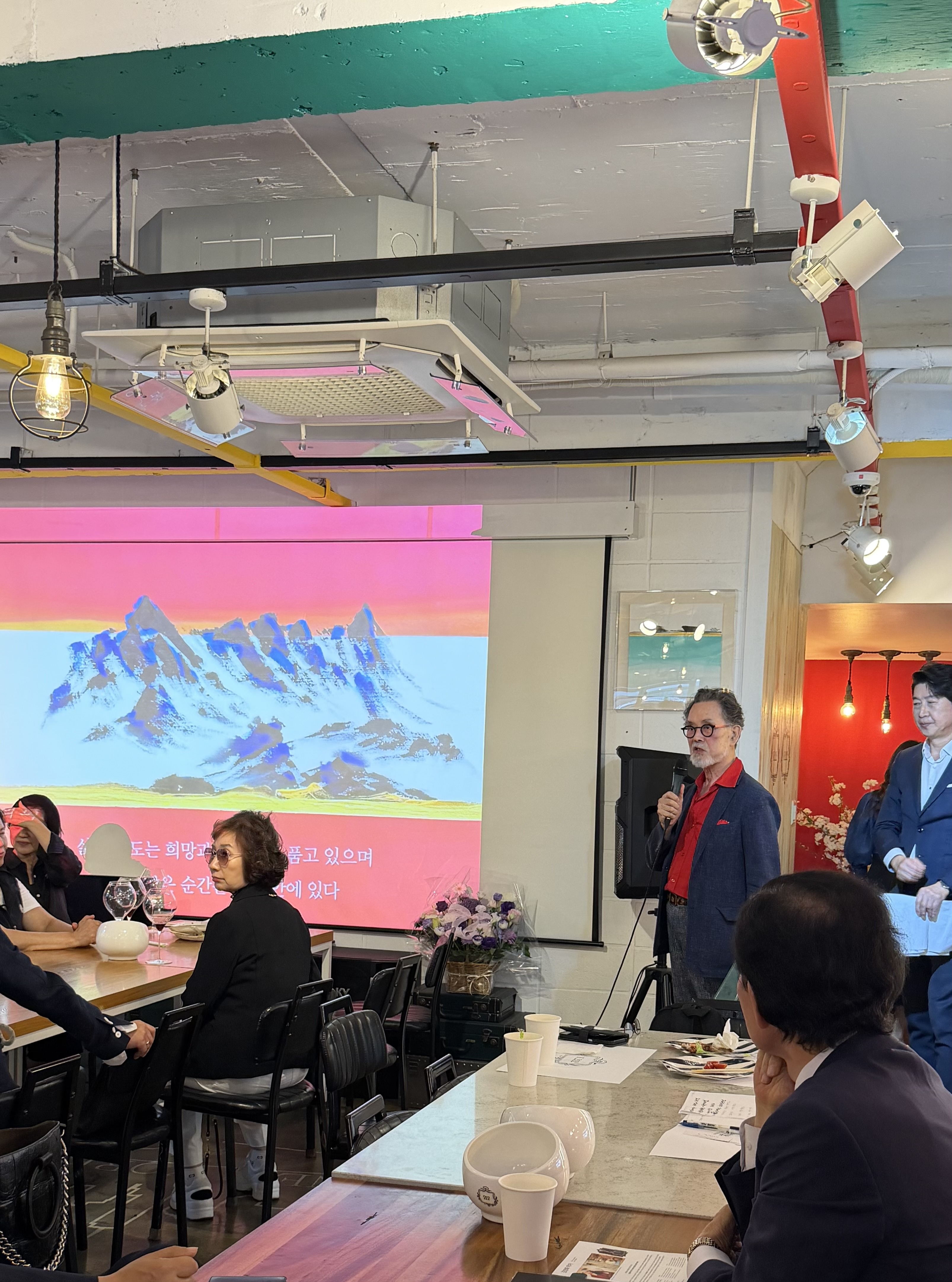
simultaneously across three distinct spaces—Itaewon K212, the PLAS Art Fair at COEX, and the Danam 818 Cafe Gallery—this exhibition represents far more than a single artist’s contemporary achievement. It stands as a profound manifesto, questioning where Korean art originated, where it stands today, and where it can journey tomorrow.
We often refer to tradition as a heritage of the past. However, true tradition is not a static form preserved inside a museum; it is a living force. It does not merely repeat itself; it is continuously reborn. In this sense, the fact that Kim Young-hwa inherits the artistic lineage of Danwon Kim Hong-do, alongside the creative soul of her late father, Kim Yun-tae—a registered intangible cultural property in pottery—is not simply a matter of biological bloodline. It signifies that a specific texture, a specific field, and a living artistic frequency are resonating once again on today’s canvas.
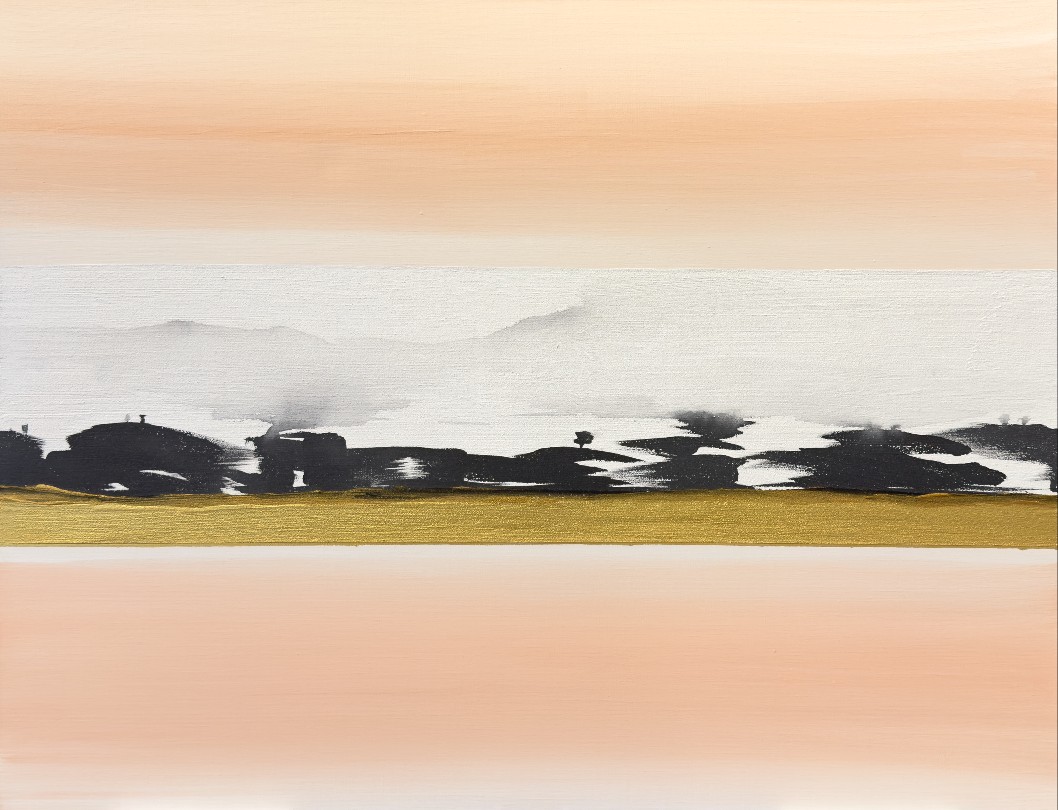
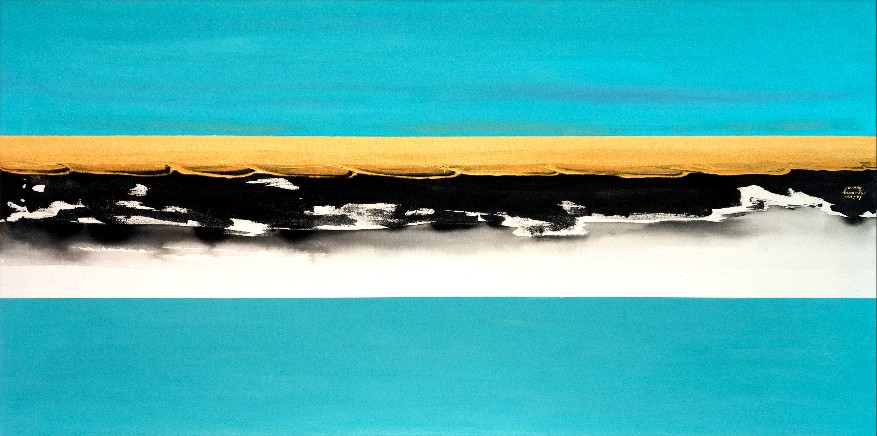
It is particularly crucial to note that "Texture, Line, and Light" are presented as the core pillars sustaining Kim’s artistic world, embodying a 300-year-old artistic soul through the physical properties of traditional ink, color powders, and clay.
From the perspective of Qiosmosis, which I have long conceptualized, art is never created solely by an individual's conscious intention. Art is an event of condensation where the hand, body, material, time, memory, ancestors, nature, and the vital energy (Qi) of the universe permeate and respond to one another, crystallizing into a singular form at a definitive moment. Kim Young-hwa's brushstroke is precisely such an event.
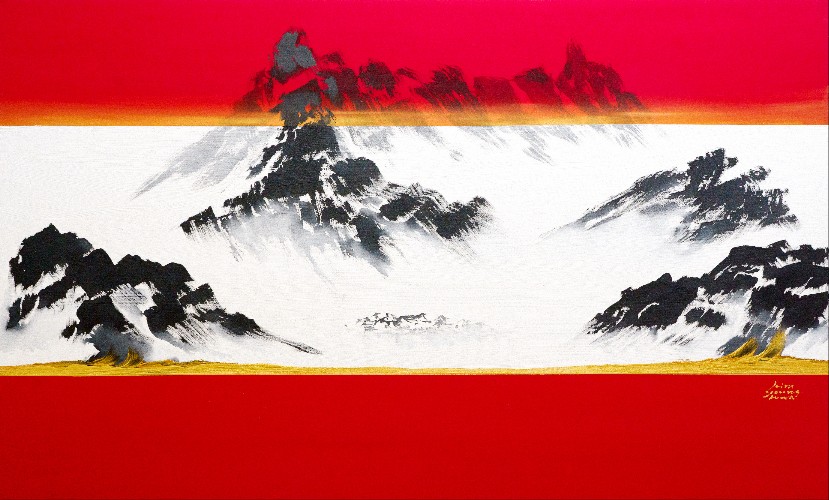
Her lines are not ordinary lines. They are not mere contours that encircle a subject from the outside; they are living traces of vital movement. If Danwon Kim Hong-do captured the daily life and dynamic vitality of the Joseon era through his lines, Kim Young-hwa captures the contemporary world, the modern human condition, and universal energy. Her lines never remain still. They run, leap, bend, collide, and open up once again.
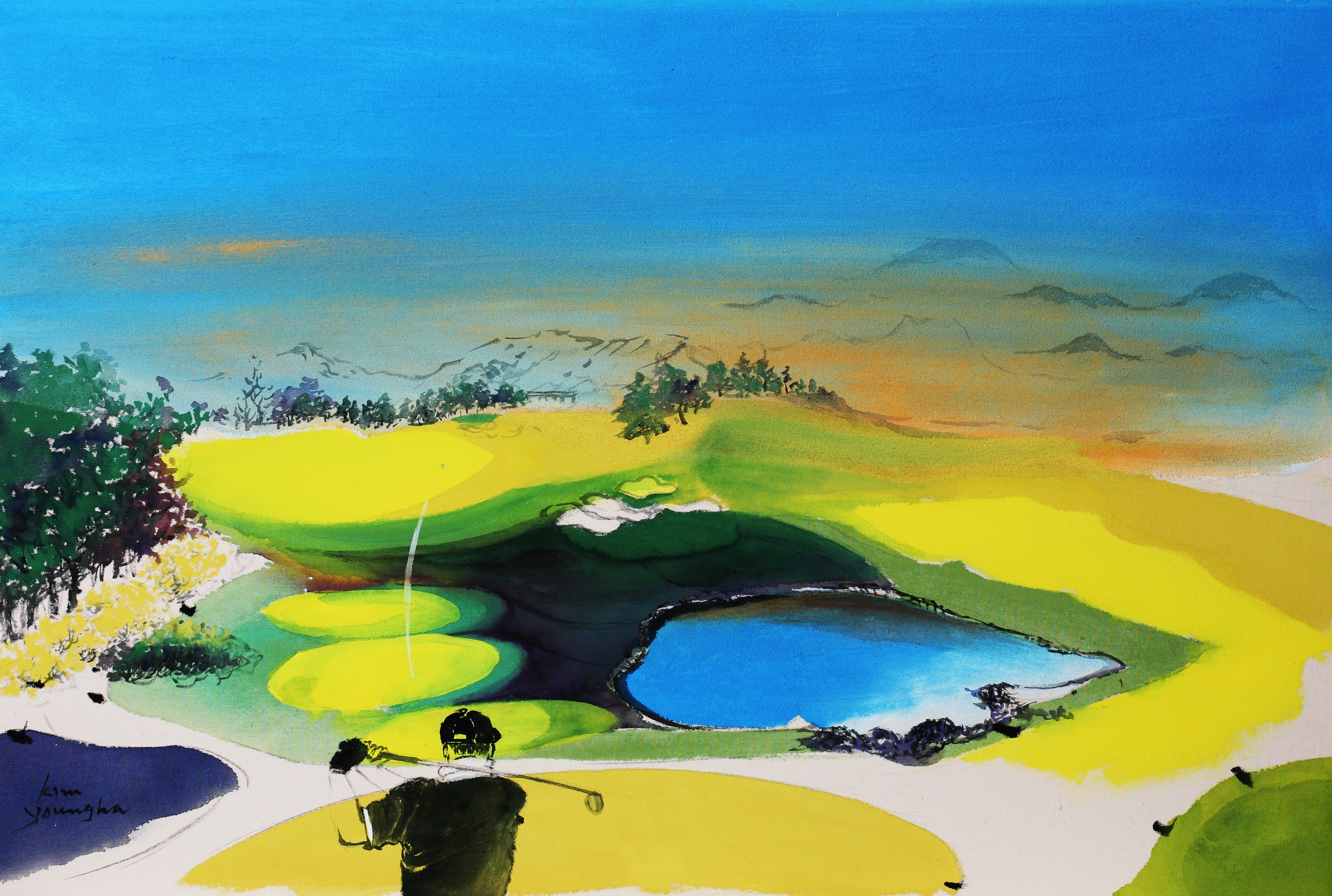
Her horse paintings and golf landscape paintings are particularly fascinating. She is highly original in that she does not view a golf course as a mere space for sports, but rather reads it as a contemporary true-view landscape (Jingyeong Sansu) where the ups and downs of life, recovery, the rhythm of Yin and Yang, the ridges of nature, and human desires converge. Discovering the curves of the female form, the masculine energy of pine trees, the transition of the four seasons, and the order of Obangsaek (traditional five cardinal colors) within an 18-hole course is not a superficial choice of subject matter. It reflects a profound worldview that perceives reality as a web of interconnected relationships. This is precisely what I call the Qiosmotic gaze. The world is not a mere collection of fixed objects, but a fluid stream of relationships. Fine art is the precise moment when that fluid stream temporarily condenses and manifests before our eyes.
Another vital element is the theme of healing that repeatedly emerges in Kim Young-hwa's oeuvre. Today, we live in an era oversaturated with images. We are surrounded by countless visuals generated by smartphones, advertisements, videos, and Artificial Intelligence. Yet, a proliferation of images does not mean we see more deeply. Instead, we consume faster, forget quicker, and react more superficially.
In such an age, Kim Young-hwa’s paintings demand that we pause and stay, rather than instantly consuming them as ephemeral images. Her Obangsaek colors are not merely decorative; they form a relational structure connecting the four cardinal directions and the center, the seasons and vital energies, the body and the universe. Her golden hues do not represent superficial luxury, but rather the light of life achieved after long, disciplined meditation. Her brushstroke is not a technical skill of the hand, but an act where her entire body becomes a medium to receive the vital energy of the cosmos.
I find it profoundly moving when Kim notes, "Paintings must inherently possess a vital force that reaches toward the light." In an era where AI rapidly synthesizes images, the way an artist triumphs over the machine is not through more precise description or accelerated production. The artist transcends the machine by polishing their inner self, thereby embedding an irreplaceable vibration of life into the artwork—a frequency that machines can never pass through. I believe the true strength of K-ART, as championed by Kim, lies exactly there.
Today, I wish to characterize Kim Young-hwa’s artistry as follows:
Her paintings do not merely preserve tradition; they re-ignite it.
Her brushstroke does not merely depict an object; it summons vital energy (Qi).
Her colors do not merely decorate a surface; they breathe open the respiration of the universe.
Therefore, while this exhibition showcases Kim Young-hwa as an individual, it simultaneously serves as an eloquent answer to what Korean art can articulate to the global stage. Korean art no longer needs to define itself on the periphery of Western art. We possess the Line. We possess the Ink. We possess Obangsaek. We hold a deep sensory attunement to clay, light, and texture. Above all, we inherit an ancient wisdom that views the world not as a cluster of rigid objects, but as a matrix of living relationships.
Kim Young-hwa revitalizes that ancient wisdom through a contemporary visual vocabulary. This is the true meaning of inheriting the 300-year-old DNA of Danwon Kim Hong-do. It is not about lineage, but resonance. It is not about genealogy, but vitality. It is not a repetition of the past, but an ignition toward the future.
I sincerely hope this exhibition transcends a magnificent personal milestone for Kim Young-hwa, serving as a powerful prelude where Korean art begins to speak with its own authentic voice on the global stage.
My heartfelt congratulations to Artist Kim Young-hwa on this extraordinary exhibition. I hope everyone gathered here today does not merely look at these paintings, but directly encounters the texture, line, light, and living energy they hold within.
#ArtCriticism #ArtReview #ArtEssay #ContemporaryArt #KoreanArtist #FineArt #ArtHeritage #HealingArt #WaterfallOfMemory #TheJoyOfGolf #GolfPainting #WrittenByHongKiRo #Aiga_kimyounghwa
'작품이야기' 카테고리의 다른 글
| Precious Mugwort (0) | 2026.07.12 |
|---|---|
| Aiga Kimyounghwa (1) | 2026.07.06 |
| My Artistic Life - Aiga_ kimyounghwa (1) | 2025.01.29 |
| aiga kimyounghwa Story (1) | 2024.12.28 |
| 한국최초 골프화가 김영화 “현대백화점”충청점 초대전 작품 (0) | 2021.04.15 |


