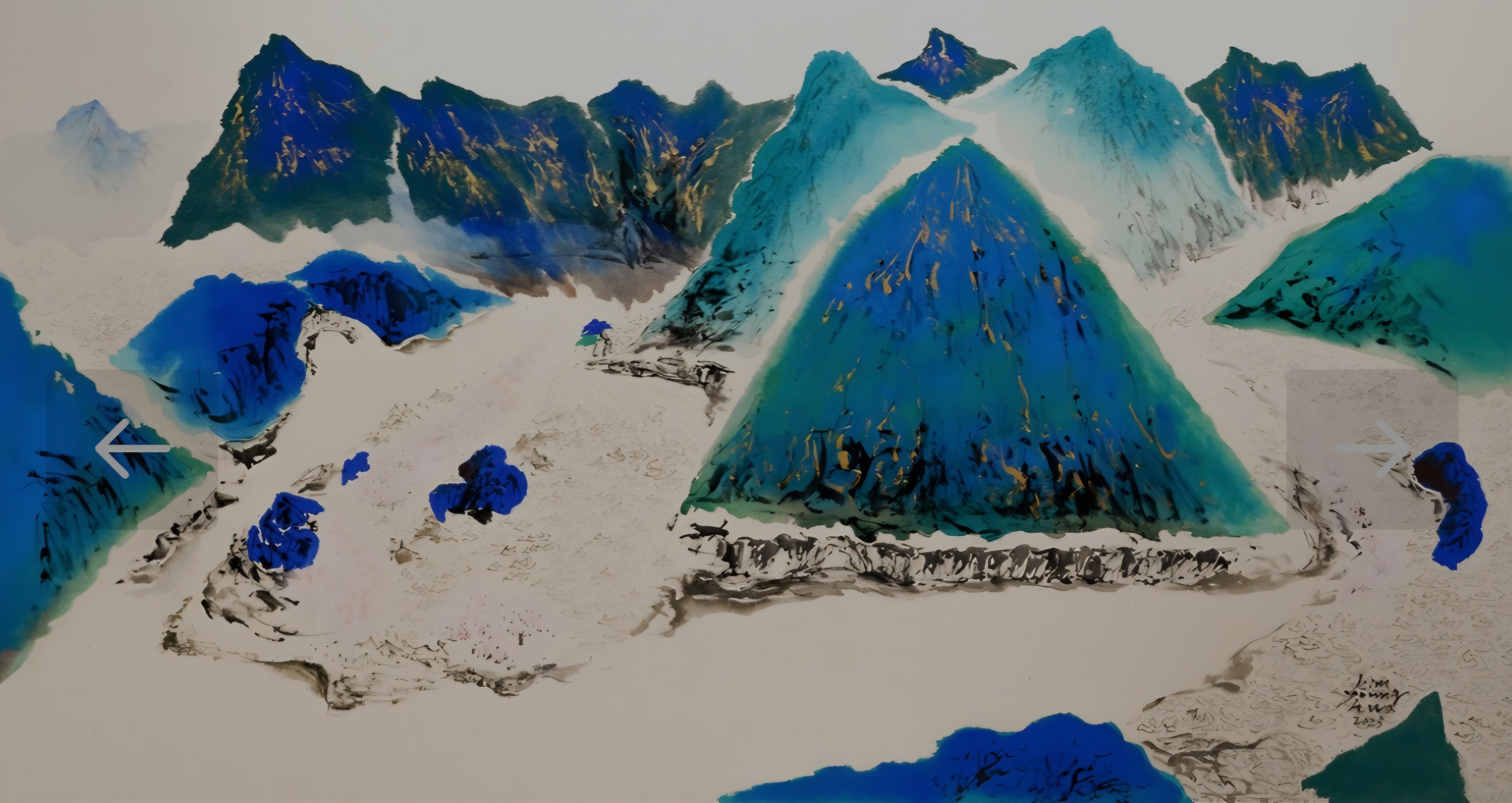
Infusing the Times with a Brush Tip Melted with Soul
From the roots of tradition to the new values of structure-centered art, the artistic world of Korean ink-wash painter Kim Young-hwa

In Kim Young-hwa's Korean paintings, the accumulated spirit of tradition flows alongside the artist's perspective on today's era.

His brush tip does not stop at reproducing traditional forms. Grounded in the historicality embedded in the materials and techniques of Korean painting, he expresses the artist's sensibility and the contemplation of the times on the canvas, bringing tradition back to life in today's language.
Korean art has captured the changing aesthetic senses and spirits of each era in painting and sculpture. Tomb murals and Buddhist art from the Three Kingdoms period expressed the worldview and beliefs of the people of that time, while Goryeo dynasty Buddhist paintings blossomed with religious sublimity and decorative beauty through delicate lines and brilliant colors.
By the Joseon dynasty, the development of literati painting, true-view landscape painting, and genre painting diversified the perspectives on nature and human life. Thus, painting became an important arena for expression, capturing not merely the depiction of objects, but the spirit, lifestyle, and aesthetic consciousness of an era.
Since the modern era, Korean painting has simultaneously faced the challenges of traditional painting's identity and modern transformation with the influx of Western painting materials and plastic concepts. Following liberation, the succession of tradition and the search for new formative languages continued, ranging from deep exploration of the spirituality of ink-wash to various experiments expanding the possibilities of materials, colors, and forms.
Today, Korean painting no longer stays confined to traditional materials and formats. It is expanding into contemporary art that transcends the boundaries of genres and media, capturing personal experiences and the sensibilities of the times.
Amidst this art-historical flow, Kim Young-hwa's work features the harmonization of tradition and modernity within a single canvas.
Based on the rhythm of brushstrokes, colors, and lines unique to Korean painting, he orderly composes the elements on the canvas. Each form possesses independent aesthetic beauty while maintaining organic relationships with one another, and these relationships combine to form the meaning and emotion of the entire work.
Therefore, for Kim Young-hwa, canvas composition is not a mere formal arrangement. It is the foundation for establishing the work's spirit and formative order, and a crucial creative principle that allows individual elements to converge into a single meaning.
This working attitude resonates with the artistic thinking pursued by structure-centered art.
Structure-centered art views a work not merely as an isolated object, but as an interconnected structure comprising its individual elements and their relationships, the artist's creative spirit, and the viewer's experience.
The value of a work extends further not only from the beauty of individual forms or techniques, but from how they form an order and relationship to create a unified artistic meaning.
From this perspective, Kim Young-hwa's work is noteworthy for constructing a new canvas order based on the traditional formative principles of Korean painting.
In his works, form, color, line, and blank space are not separate elements, but form a unified formative relationship that builds the overall meaning of the work. Starting from tradition yet not remaining within it, he opens up new possibilities for appreciation through his own formative language.
This is an important point showing that Korean painting can create new values within contemporary art rather than merely preserving past heritage.
The Portrait of King Muryeong Embodying History and Spirit
In understanding Kim Young-hwa's artistic world, the creation of the portrait of King Muryeong holds significant meaning.
Producing a portrait of a historical figure is not simply a task of reproducing physical appearance. It is a work that must encompass the era and historical background the person lived in, the spirit of that era, and the memories and evaluations of posterity.
Therefore, a portrait is an artistic act that visually inherits history and memory beyond simply recording a person's appearance.
Kim Young-hwa's creation of the portrait of King Muryeong is meaningful as a task that connects the spirit of traditional portraiture with today's brush tip. By reviving a historical figure through the traditional formative language of Korean painting, it prompts a reconsideration of the historical and public significance inherent in Korean painting.
In particular, by exploring both the spirit of traditional portraiture and modern formative sensibility, it naturally connects with the direction of harmonizing tradition and modernity that his work aims for.
Transcending Tradition: New Possibilities for Korean Painting
The reason Kim Young-hwa receives attention lies not solely in traditional craftsmanship or canvas perfection.
He has spent a long time researching painting techniques and formative principles to refine his own visual language, while persistently exploring how Korean painting can communicate with today's audience.
His works embody both Korean sentiment and contemporary sensibility. Familiar traditional aesthetics are reinterpreted through new canvas compositions, allowing viewers to simultaneously encounter the deep roots of Korean painting and its future possibilities.
Ultimately, Kim Young-hwa's work can be described as an independent world of Korean painting formed on two axes: the succession of tradition and its modern reinterpretation.
Rather than blindly repeating tradition, he understands its spirit and reconstructs it with contemporary sensibilities, thereby demonstrating the new roles Korean painting can play within contemporary art.
Expanding Art's Value from Appreciation to Collection Culture
The value of a work does not end at the moment of appreciation.
When a work remains in a person's space for a long time, accumulating memories and meanings, art transcends personal appreciation to become a part of life and culture. Collecting a work goes beyond merely possessing a physical object; it is an act of preserving the artist's spirit and the historical significance imbued in the work together.
From this perspective, a new collection culture can be fostered when the artistic charm and formative perfection of a work combine with the cultural meaning of collection.
Kim Young-hwa's works possess the potential for such a new collection culture by simultaneously presenting the traditional beauty and modern formative sensibilities inherent in Korean painting.
When artists, collectors, and viewers connect through the artwork and share artistic values, art becomes a cultural medium connecting people to people, and the past to the present, moving far beyond a mere object of appreciation.
Brush Tip Embracing the Times, Heading Toward the World
Kim Young-hwa's art extends the canvas of Korean painting into a new arena of value creation by carrying the depth of tradition into today's language.
Through his brush tip, tradition is reborn not as a heritage trapped in the past, but as a living spirit connecting the present and the future.
In particular, his work points the way for contemporary Korean painting by combining the traditional formative principles of Korean painting with his own canvas order, presenting new possibilities of appreciation through the relationships between form, color, line, and blank space.
Korean painter Kim Young-hwa reads the times with a soul-infused brush tip and builds a new formative order beyond tradition.
His art departs from the historical roots of Korean art, meets contemporary sensibilities, and opens up new possibilities to share the unique aesthetics and spirit of Korean painting with the world.
Kim Young-hwa's Korean painting advances beyond the succession of tradition into the art of a new era.
Representative Baek Yong-hyun
'Interview ㅣ 관련기사' 카테고리의 다른 글
| AIGA younghwa kim held an exhibition in Mexico (0) | 2023.12.11 |
|---|---|
| "Finding Healing at AIGA Young-hwa kim Exhibition in Mexico." (0) | 2023.12.08 |
| Blanc Blue Art Fair & JAMI Gallery - AIGA Younghwa Kim Special Exhibition (0) | 2023.12.05 |
| Kim Young-hwa's charity exhibition "GOLDEN Moments of Magic Exhibition." (0) | 2023.11.04 |
| "Korea's top female artist Kim Young Hwa" (0) | 2023.09.27 |